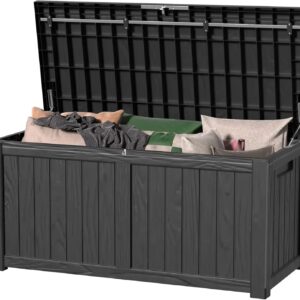
Spring comes. You pull the cover off the patio set and the whole thing looks green. Most advice on how to clean outdoor furniture tells you to grab soap and a hose, which works fine on resin and quietly ruins teak. Material decides the method. It also decides which cleaner will strip the finish and which pressure setting will carve lines into a plank. Below you’ll find the two cleaners that handle nearly everything, a breakdown for each material, safe pressure ranges, plus the drying rule that stops mildew coming back. If you finish the season wondering where the cushions go, the waterproof resin deck boxes at the end solve that half.
Quick Answer at a Glance
Wash with warm water and a squirt of dish soap on a soft brush. Rinse fully. Dry before covering. Treat mildew with an oxygen bleach solution, not chlorine bleach, on anything that isn’t white plastic. Never point a pressure washer at cushions, sling fabric or natural wicker. Everything below is detail on those five lines.
| Material | Cleaner that works | Never use | Dry time before covering |
|---|---|---|---|
| Resin and plastic | Dish soap. Diluted chlorine bleach on white only | Abrasive pads | 2 hours in sun |
| Powder-coated metal | Dish soap, soft cloth | Scouring powder, wire brush | 2 hours |
| Wrought iron | Dish soap, then car wax | Chlorine bleach | 4 hours |
| Teak and hardwood | Oxygen bleach solution, soft brush | Chlorine bleach, wire brush | 24 to 48 hours |
| Synthetic wicker | Dish soap, soft brush, low rinse | Pressure washer | 4 hours |
| Cushions and sling | Oxygen bleach solution, soft brush | Machine drying, pressure washer | 48 hours |
What Actually Damages Patio Furniture
Dirt is the least of it. Four things do the real harm and they need different answers. Organic growth comes first. Mildew and algae feed on pollen and dust that settle in the weave of a cushion or the grain of a plank. They aren’t stains sitting on top. The roots go into the surface, which is why a rinse makes them fade and a week later they’re back.
Then there’s trapped water. A cover thrown over a damp chair creates a sealed, warm pocket. That pocket grows more mildew in a fortnight than an open patio does in a season. More furniture is ruined by covering it wet than by leaving it out. UV does slower damage. It fades resin, chalks powder coating and greys teak. Cleaning won’t reverse it. Wax and sealant slow it.
Last is the wrong chemical. Chlorine bleach on wood breaks down the fibres and leaves a fuzzy grey surface. On powder-coated aluminium it eats the coating from the edges inward. That damage doesn’t show for a month.
The Two Cleaners That Cover Almost Everything
You need less than the cleaning aisle suggests. Two mixes handle the whole patio. Mix one is warm water with a few drops of dish soap. This is the weekly and seasonal wash for every material on the list. Nothing about it is clever. A soft brush plus surfactant lifts pollen and dust before either can feed anything.
Mix two is an oxygen bleach cleaner, sold as a powder you dissolve in warm water. Oxygen bleach releases hydrogen peroxide as it breaks down, which kills mildew spores without stripping colour or attacking wood fibre. It’s the safe answer for cushions, teak, wicker and painted surfaces. Chlorine bleach belongs on white plastic and nowhere else on a patio.
The Wash That Works on Everything
1. Move the furniture off the deck and onto grass or a driveway so runoff doesn’t sit on decking.
2. Dry brush the loose dust off first. Washing dust turns it into mud you then have to chase.
3. Mix warm water with a few drops of dish soap in a bucket.
4. Work top down with a soft brush, one section at a time. The solution should never dry on the surface.
5. Rinse with a hose from the top down until the water runs clear.
6. Tip chairs to drain trapped water out of frame tubes and cushion seams.
7. Leave everything in full sun until it’s dry to the touch on both faces.
8. Only then apply wax, sealant or a cover.
Material by Material
Resin, Plastic and HDPE
The easiest surface on the patio. Soap solution and a soft brush lift almost everything. For white plastic that has gone yellow or spotted, a weak chlorine bleach solution restores it, roughly a third of a cup to two thirds of a cup of water, wiped on and rinsed off within a few minutes. Skip abrasive pads. They scratch a matte haze into the surface that traps dirt worse than before.
Powder-Coated Aluminium and Steel
Soap and a soft cloth, then a rinse and a towel dry to stop water spots. Check the feet and joints for chipped coating while you’re there. Bare metal under a chip rusts outward beneath the paint. A dab of touch-up enamel on a dry chip saves the frame. No scouring powder and no wire brush, ever.
Wrought Iron
Same soap wash, then look for rust bloom at welds and feet. Sand light rust with fine paper, prime the bare spot, then wax the whole frame with ordinary car paste wax twice a year. Wax is what keeps water off the metal between washes.
Teak and Other Hardwood
Teak greys because UV oxidises the surface, not because it’s dirty. Like the silver look? A soap wash once a season is the whole job. Want the honey colour back? Use an oxygen bleach solution and light strokes along the grain, never across it. Rinse well and dry it a day or two before oiling. Sealing damp wood traps moisture under the finish.
Wicker, Natural and Synthetic
Vacuum the weave first with a brush attachment. Synthetic wicker takes a soap wash and a gentle rinse. Natural wicker takes a barely damp cloth and nothing more, since soaking swells the fibres and they crack as they dry. Keep pressure washers away from both.
Cushions, Slings and Umbrellas
Check the care tag before anything else. Most covers unzip and take a cold machine wash, then air dry only. For fixed cushions, brush an oxygen bleach solution into the fabric, let it sit for around fifteen minutes, then rinse until no foam comes out. Stand cushions on edge to dry so both faces get air. A cushion that feels dry on top can hold water in the foam for another day.
Kit That Makes This a One Afternoon Job
Four items from the Urbano Mart outdoor range, split between the washing half and the storing half.
-
Sale!

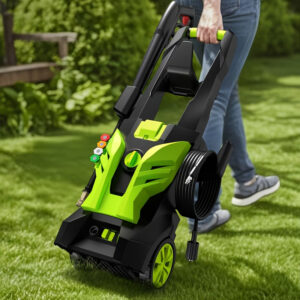
Portable High-Pressure Washer For Cars, Driveways, Patios & Fences
Rated 4.82 out of 5$250.00Original price was: $250.00.$195.00Current price is: $195.00. Add to cart -
Sale!

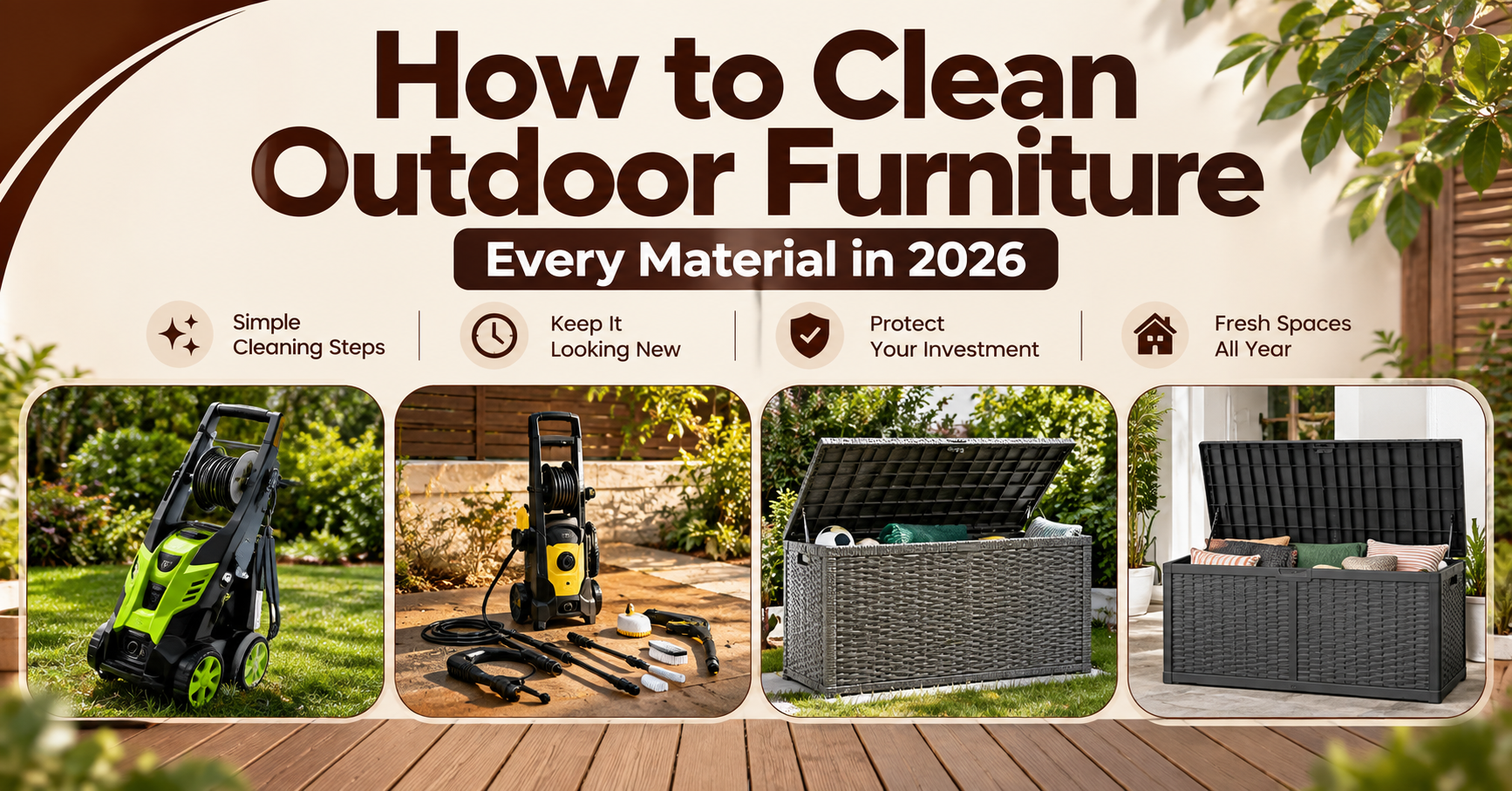
Electric Pressure Washer for Car, Patio, Deck & Outdoor Cleaning
Rated 4.57 out of 5$250.00Original price was: $250.00.$155.00Current price is: $155.00. Add to cart -
Sale!

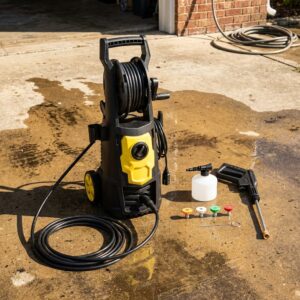
100-Gallon Large Outdoor Storage Box โ Waterproof Resin Patio Deck Box with Lockable Lid
$285.00Original price was: $285.00.$135.00Current price is: $135.00. Select options This product has multiple variants. The options may be chosen on the product page -
Sale!

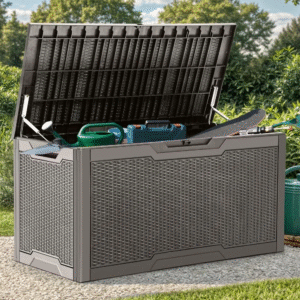
120 Gallon Waterproof Resin Deck Box โ Outdoor Storage Box with Lockable Lid
$388.00Original price was: $388.00.$175.00Current price is: $175.00. Add to cart
Electric Pressure Washer for Car, Patio, Deck and Outdoor Cleaning
2000 PSI at 1.65 GPM with four quick-connect nozzles at 0, 15, 25 and 40 degrees, a 20 foot hose and overheat protection that cuts the motor above 105 Celsius. The 40-degree tip is the one you’ll use on furniture. At 18 pounds it carries around the yard one-handed. If you only have fabric and wicker furniture, you don’t need it at all.
Portable High-Pressure Washer For Cars, Driveways, Patios and Fences
Up to 2.5 GPM, four metal nozzles at the same four angles, dual rollers and an anti-tipping base. Higher flow moves algae off pavers and fence panels faster than a narrower jet does. The listing doesn’t state a PSI figure. Treat the nozzle angle rather than the number as your safety control on furniture.
120 Gallon Waterproof Resin Deck Box with Lockable Lid
54.25 by 26.5 by 24.21 inches of poly resin that resists UV, water, rust, peeling and warping, with gas struts on the lid and a lockable latch. The flat top seats two adults. Clean cushions go in here dry and stay dry, which is the step that decides whether they survive to next summer. It’s a big footprint for a small balcony.
100-Gallon Large Outdoor Storage Box with Lockable Lid
45.4 by 21.7 by 23 inches, double-wall resin with internal steel beams, rated to support up to 485 pounds as a bench. Hydraulic pistons hold the lid open while you load. Assembly runs under half an hour. At 27 pounds empty it moves easily, though that also means it needs weighting or shelter in high wind.
Mildew and Mold: Getting It Out for Good
A mildew remover only works if it reaches the roots. Wet the area first so the solution soaks in rather than beading off. Brush on your oxygen bleach mix, then wait. Fifteen minutes of contact time does more than fifteen minutes of scrubbing.
Rinse until the water runs clear and no suds appear when you press the fabric. Residue left in a cushion attracts dirt and gives the next bloom something to feed on.
Then fix the cause. Mildew returns because the item stays damp, sits in shade or gets covered before it dries. Move a chronically green chair into sun for a week and watch what happens without any chemical at all.
Pressure Washer PSI by Material
Here’s the section almost nobody writes. It’s where most furniture gets wrecked. Pressure alone isn’t the danger. The nozzle angle and your distance from the surface matter more than the number on the box.
The 0 degree red tip is a cutting jet. It has no use on furniture of any kind. Start with the 40 degree tip, stand three feet back, then move closer only if you need to. Test on the underside of a leg first.
| Material | Safe ceiling | Nozzle | Distance |
|---|---|---|---|
| Resin and plastic | Around 1,300 PSI | 40 degree | 12 inches or more |
| Powder-coated metal | Around 1,500 PSI | 40 degree | 12 inches or more |
| Wrought iron | Around 1,200 PSI | 40 degree | 18 inches, skip flaking paint |
| Softwood, pine and cedar | 500 to 800 PSI | 25 to 40 degree | 18 inches, along the grain |
| Teak and hardwood | 500 to 600 PSI | 40 degree | 18 inches, along the grain |
| Synthetic wicker | Hose only | None | Not suitable |
| Cushions, sling and umbrellas | Hose only | None | Not suitable |
A 2000 PSI machine is still safe on wood if you back off and widen the fan. Distance drops effective pressure quickly. Most machines also lose pressure through the detergent setting, which is another way to bring it down.
Patio Furniture Covers or Storage: Which One Wins
Covers are convenient and they’re also how most cushions die. A cover holds whatever moisture was underneath when you put it on. Use covers for the frames that stay outside all winter, the tables and the heavy pieces. Choose vented covers, tie them down so wind can’t flap them, then lift them on the first dry day of the month to let air through.
Use a sealed box for anything soft. Cushions, throws, umbrella canopies and outdoor rugs belong in a dry container, not under a sheet. A 75 Gallon Waterproof Resin Deck Box with Wheels handles a two-seater set and rolls into a garage corner when the weather turns.
The 48 Hour Rule
This is the rule that decides everything else. Nothing soft goes into storage until it’s been dry for 48 hours, not dry to the touch for two. Foam cushions hold water in the core long after the cover feels ready. Press hard in the middle with your palm. If the fabric darkens at all, water is still in there. Stand them on edge, rotate them once a day, then give them the full two days. Wood needs the same patience for a different reason. Sealing or covering damp teak locks moisture under the finish, which lifts the oil and grows mildew from underneath. One dry weekend beats a whole season of repair.
Five Mistakes That Cost You a Season
1. Using Chlorine Bleach on Wood or Fabric
Chlorine bleach on wood or fabric. It weakens fibres and the damage shows up as fraying months later.
2. Washing in Direct Midday Sun
Washing in direct midday sun. The solution dries before you rinse it, which leaves streaks that are harder to shift than the original dirt.
3. Using a Stiff Brush on Powder Coating
A stiff brush on powder coating. Fine scratches let water reach the metal. Rust then starts under the paint where you can’t see it.
4. Stacking Chairs While Damp
Stacking chairs while damp. Trapped water between seats is exactly the environment mildew wants.
5. Skipping the Frame Drain
Skipping the frame drain. Tubular metal chairs fill through the leg caps and hold that water all winter, which is what rusts them from the inside out.
Two Patios, Two Fixes
One reader kept cushions under a fitted cover all winter and unwrapped black spotting every April. They were going under damp. Moving them into a 100 gallon resin box after a two day dry, with the cover left on the frames only, ended the cycle in one season.
Another had grey teak and reached for chlorine bleach. It lifted the grey and left a soft grain that shed splinters. An oxygen bleach wash on the remaining pieces brought the colour back without the fuzz.
About the Author
The Urbano Mart Team covers outdoor storage, patio furniture and home decor for customers across the United States, from a business formed in Michigan in 2022. The team handles resin, powder-coated metal and wood products daily. The advice here follows what customers report after a full season outdoors.
Wrap Up
Knowing how to clean outdoor furniture comes down to matching the cleaner to the material, keeping the pressure wide and low, then giving everything two full days to dry before it goes away. Do those three things and a patio set lasts years past the point most people replace it. When the cushions need somewhere dry to live, browse the outdoor storage boxes or contact Urbano Mart at sales@urbanomartllc.com or +1 313 487 8379, Monday to Friday, 9:00 AM to 5:00 PM EST. Free shipping applies across the USA except HI, PR, AK and GU, with delivery in 5 to 8 working days.