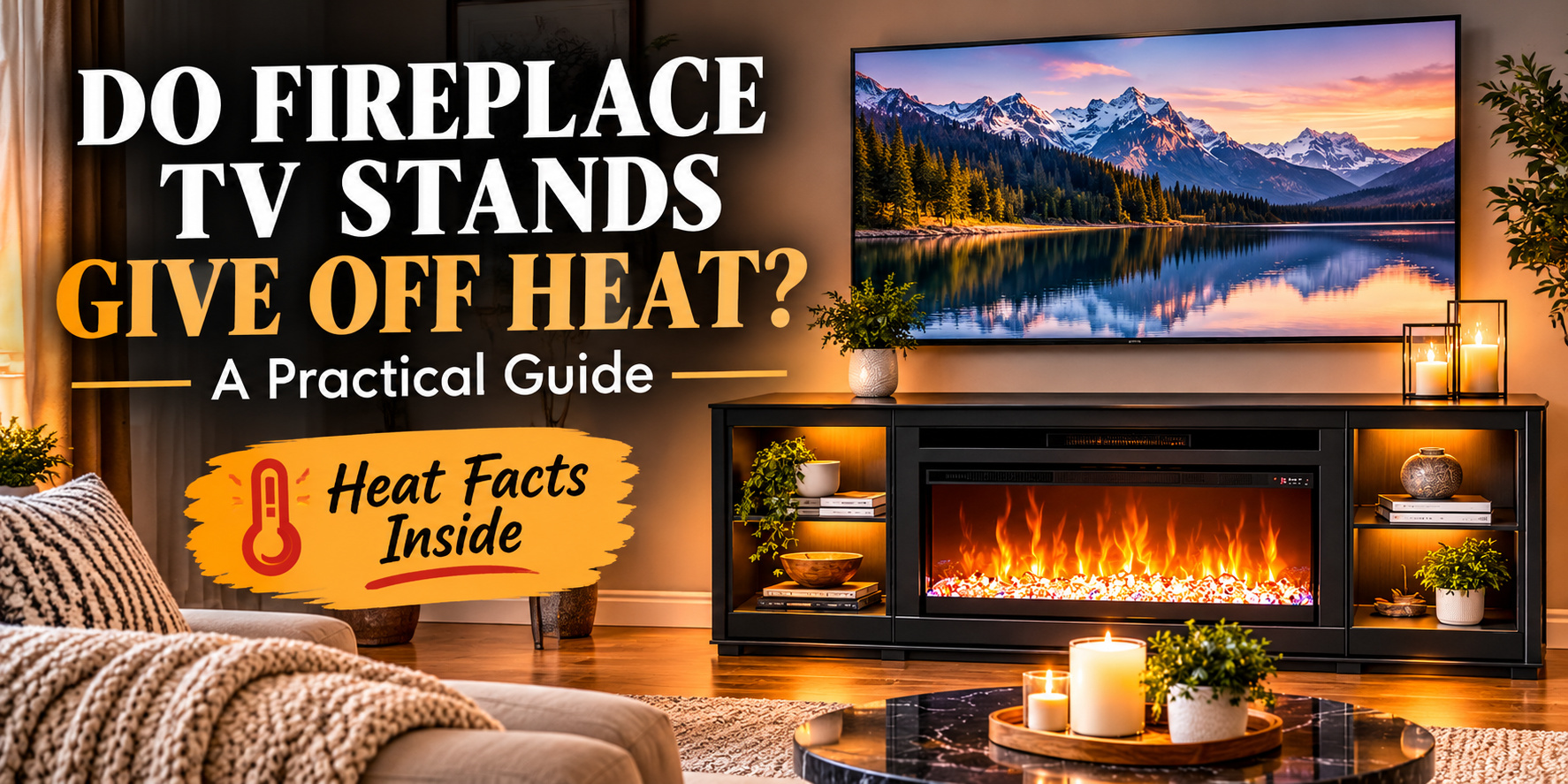

If you love the idea of a fire glowing under your TV but worry about the power bill, you are not alone. The good news is that a tv stand fireplace does not use nearly as much electricity as most people fear.
With the heat switched on, a typical model uses about the same electricity as a standard plug-in space heater. And when you run the flame effect by itself, a fireplace tv stand uses only a small fraction of that. Here is how the numbers actually break down, in plain dollars and cents.
The Short Answer: TV Stand Fireplace Uses About as Much as a Space Heater
Almost all of the electricity goes to one part: the heating element. The flame effect, the lights, and the small motor that makes the flames flicker use very little power on their own.
In other words, a tv stand fireplace is best thought of as a space heater built into a piece of furniture. If you would be comfortable running a space heater in your living room for the evening, the cost of running one of these units will feel familiar, not shocking.
That also means there is no single fixed cost. What you pay depends on three things: how powerful the heater is, how many hours you run it, and what your local power company charges per kilowatt-hour. The next section walks through the math with real numbers.

How Much Electricity Does an Electric Fireplace TV Stand Use?
Heat Mode: Where the Power Goes
Most tv stand fireplaces sold in the US have heaters rated between 1,300 and 1,500 watts. A very common size is 1,400 watts, and that is the number we will use for the math in this article.
Watts can be confusing, so here is the simple version. One thousand watts equals one kilowatt. Running a 1,400 watt heater for one hour uses 1.4 kilowatt-hours, written as 1.4 kWh. Your power bill is based on kilowatt-hours, so that is the only number you really need.
The average US residential electricity rate is about 17 cents per kWh, though your own rate may be a little lower or higher. Multiply 1.4 kWh by 17 cents and you get roughly 24 cents per hour with the heat on full.
So a three-hour movie night costs about $0.71 in electricity. Run it three hours a day, every day, and you are looking at roughly $21 a month. That is real money, but it is a long way from the bill shock many people imagine.
Flame-Only Mode: Almost Nothing
Turn the heat off and the picture changes completely. The flame effect is usually made with LED lights and a small rotating reflector or a digital display. Together they draw only a few watts, a tiny fraction of what the heater uses.
On flame-only evenings, your fireplace tv stand is drawing roughly the power of a single light bulb. An entire evening of ambience costs a few cents, and a full month of nightly flame-only use would barely register on your bill. For many owners, this is the mode that gets used most of the year. It is also the mode where styling carries the room, since the glow is the whole show — our guide to how to decorate a fireplace TV stand shows how to dress the top for it.
How It Compares: Space Heaters and Heating the Whole House
Against a plug-in space heater, there is no real contest to judge, because they are near enough the same appliance. A typical space heater also runs at about 1,500 watts, so it costs about the same per hour. The difference is comfort and placement: the heater is built into your furniture, aimed at the sofa, and it looks considerably better while doing it.
The bigger comparison is with heating the whole house. Raising your main thermostat heats every room, including the bedrooms, hallway, and kitchen you are not sitting in. Heating only the living room for the evening, and letting the rest of the house stay cooler, is often called zone heating.
That is exactly the job a fireplace tv stand does well. You stay warm where you actually are, while your furnace or central system runs less. For many homes, the savings from turning the whole-house thermostat down a couple of degrees in the evening are bigger than the cost of the insert itself.
A Worked Example: One Fireplace TV Stand, Real Numbers
General numbers are helpful, but specific ones are better. The figures below use a real model: an entertainment center with fireplace in a 70 inch distressed white farmhouse style, with a 42 inch electric insert.
Its key numbers are typical for this category: 1,400 watts of power, 4,777 BTU of heat output, and enough warmth for rooms up to 400 square feet. It has a thermostat you can set between 64°F and 82°F, a timer that runs from 1 to 8 hours, 7 flame colors, and a remote control, so you can adjust everything from the sofa.

Because this fireplace tv stand is rated at 1,400 watts, the math is the same as the example above: about 24 cents per hour at full heat, about $0.71 for a three-hour evening, and about $21 a month at three hours a day.
In practice, most evenings cost less than that. Once the room reaches the temperature you set on the thermostat, the heater cycles off and only the flame keeps running. On a mild night, the heater might only be drawing full power for half the evening, which brings the real cost closer to 12 to 15 cents an hour.
Simple Ways to Keep Running Costs Down
You do not need to give up your tv stand fireplace on weeknights to keep the bill sensible. A few habits make a real difference:
Use the thermostat, not just the on switch. Set it a degree or two above the room temperature and let the heater cycle on and off instead of running flat out all evening.
Use the timer. Set it for one or two hours when you sit down. If you fall asleep on the sofa, the heat stops on its own instead of running until morning.
Try flame-only evenings. In spring and fall, or any night when the room is already comfortable, skip the heat and enjoy the glow for a few cents.
Heat the room you are in. Close the door, pull the curtains, and let the rest of the house stay cooler. Zone heating only saves money if the main thermostat stays down.
Keep the heater’s path clear. Leave space in front of the vents and keep throws and cushions away from the intake, so the unit heats the room instead of working against a blockage.
Costs are only half the running picture — placement and protection features matter just as much. If you have not checked them yet, our guide on whether fireplace TV stands are safe covers the features and rules to look for.
Conclusion
So, does one of these units use a lot of electricity? Honestly, no more than the space heater many homes already own, and far less than heating every room in the house. Used with its thermostat and timer, a tv stand fireplace is one of the cheaper ways to make a living room feel warm and finished, and its flame-only mode costs almost nothing at all.

Frequently Asked Questions
Can you run a tv stand fireplace with the flame but no heat?
Yes. Almost every tv stand fireplace lets you run the flame effect completely on its own, with the heater switched off. It is the most popular way to use one in warmer months, and it costs only a few cents an evening.
Does a tv stand fireplace need a special outlet?
No. A standard US household outlet is fine, because these units are designed to plug in like any other appliance. Plug it directly into the wall outlet rather than a power strip or extension cord, and you are set.
Will a tv stand fireplace trip a breaker?
Usually not. A 1,400 watt heater draws about 12 amps, which a normal 15 amp circuit can handle on its own. Trips tend to happen when the same circuit is also running another hungry appliance, like a microwave, a hair dryer, or a second space heater.
Is a fireplace tv stand cheaper to run than a space heater?
It is about the same. Both appliances use a similar amount of power, so the cost per hour is nearly identical. Any savings come from how you use it: the thermostat, the timer, and heating one room instead of the whole house.
Does the timer on a tv stand fireplace save electricity?
Yes, in a simple and practical way. The timer stops the heater from running after you have gone to bed or left the room, which is when the most waste happens. Setting it for the length of a movie or an evening is an easy habit that quietly trims your monthly cost.