

Your shed started tidy. Then the leaf blower went in, then two paint cans, then the bag of soil you meant to use last spring. Now the door opens halfway and you park the mower against whatever gives. Most shed organization ideas online hand you a pile of hooks and bins, which treats the symptom. The real fault is layout. When nothing has a fixed address, every item lands wherever there’s a gap that day. Below is a zoning method. Then the wall limits nobody warns you about. Then an upkeep routine that survives a busy month. If the shed itself has run out of room, the metal and resin storage sheds at Urbano Mart start where this article ends.
Organize by zone, not by object. Split the shed into four zones set by two things: how often you reach for an item and how heavy it is. Heavy and rare goes low and deep. Light and daily goes high and near the door. Give every zone a physical edge with a shelf, a rack or a cabinet. That edge is what stops the layout drifting back into a pile.
| Zone | What lives there | Where it sits | What holds it |
|---|---|---|---|
| 1. Daily | Hand tools, gloves, hose fittings, spare fasteners | Wall beside the door, chest height | Pegboard or wall rail |
| 2. Weekly | Mower, blower, wheelbarrow, trimmer | Floor, back half, on a marked square | Bare floor plus a wheel stop |
| 3. Seasonal | Snow gear, planters, holiday bins, spare hose | High shelf or overhead rack | Labelled opaque totes |
| 4. Hazard | Fuel, paint, fertiliser, pool chemicals | Low, vented, away from the door | Lockable resin cabinet |
Watch what happens on a Saturday. You pull out the mower, cut the grass, then carry it back with muddy hands and a phone ringing. The mower goes wherever it fits. Two feet of floor is gone. That’s floor creep. It starts at the door because the doorway is the path of least effort.
From there it spreads inward until the back wall is unreachable. Every item you can’t reach becomes an item you replace instead of finding. Shed organization ideas that only add storage never fix this. You need a rule about where things land when you’re tired.
An item gets put back in one movement or it doesn’t get put back at all. If returning the hedge trimmer means moving a tote, lifting a box and shuffling a bag of soil, it will lean against the wall instead. Design each zone so the thing you use most needs zero obstacles cleared. Shed storage solutions fail on friction, not on capacity.
Empty it. All of it, onto a tarp on the lawn. You can’t plan around clutter you can’t see.
Now measure the interior width, depth and height. Note where the door swings. Mark a walking path at least 24 inches wide from the door to the back wall. That path is sacred. Nothing gets stored in it, ever, no matter how temporary the excuse sounds.
Sort the pile on the tarp into the four zones from the table. Weight decides height. Frequency decides distance from the door. A 40-pound bag of soil belongs on the floor at the back. A trowel belongs at eye level within arm’s reach of the doorway. Once you can see the four groups on the grass, you know exactly what storage to buy. Not one hook more.
A tall walk-in shed gives you wall height. Shelving and pegboard do the heavy lifting there. A horizontal or lean-to unit gives you depth and a lid, which suits bins and long-handled items rather than shelves. Trying to run a wall system inside a low horizontal box wastes a weekend. Shape decides method.
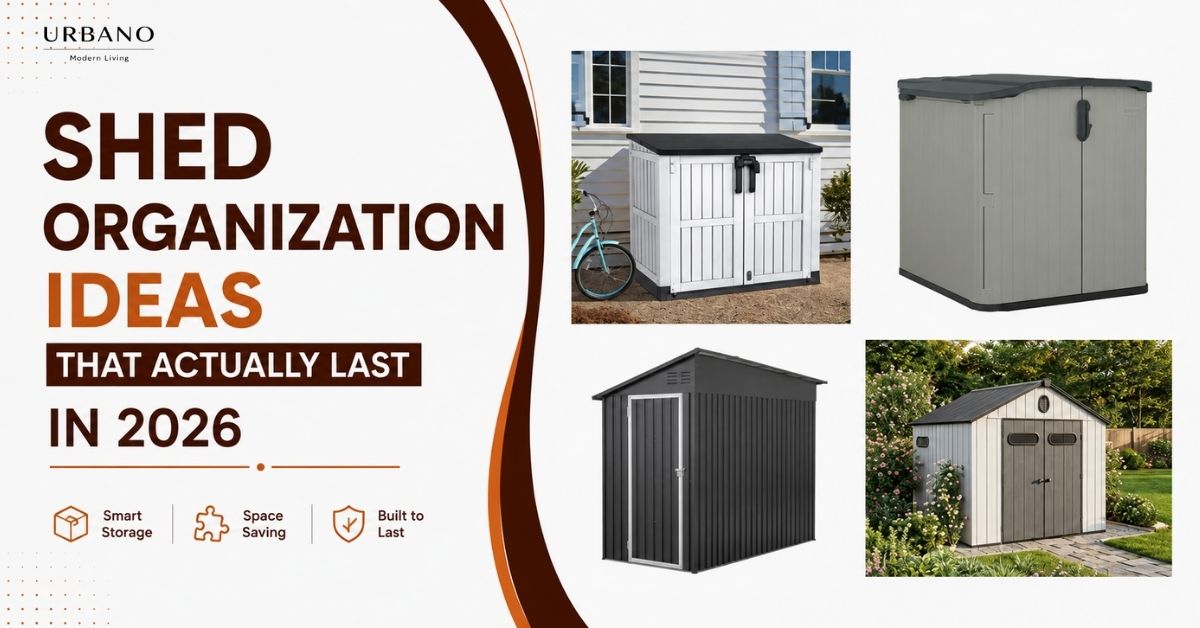
Four units from the Urbano Mart range, each one matched to a zone above.
This is a Zone 4 answer. Fuel cans, paint and lawn chemicals sit outside the shed proper in a sealed resin cabinet with a sloped waterproof lid and a step lock, which keeps fumes and spills away from anything fabric. It measures 49.8 inches wide by 28.8 deep by 43.3 high and holds 36 cubic feet. It won’t take long-handled tools standing up. Rakes and shovels stay on the shed wall.
Zone 2 overflow for the bulky things that eat your floor. Galvanized steel, 90.1 inches deep by 43.6 wide by 75.7 high, with built-in air vents and a lockable latch. The lean-to shape sits flush against a house or patio wall. A mower and a bike leave the main shed entirely. No floor is listed with it, which means you’ll want a level slab or paving underneath before assembly day.
Zone 3, the seasonal layer. At 138 cubic feet with a Glidetop sliding lid and a three-door locking system, it swallows planters, hose reels and winter gear that only move twice a year. The floor comes included, which matters for anything that shouldn’t touch damp ground. Lid access means you can’t mount shelving inside it. Treat it as a bin, not a cupboard.
Pick this when zoning proves the shed is the problem. 427 cubic feet, 91 inches square and 95 high, with skylights, side windows and louvered vents, which is enough daylight to actually find things without a torch. The reinforced resin floor and sloped roof handle wet ground. It weighs 284 pounds and needs two people plus a level base. Not a Sunday afternoon job.
Load ratings vary by brand. Read the sticker on the unit you buy. The pattern below holds across most of them.
| Shelving type | Typical load per shelf | Floor space used | Works on a resin or metal shed? | Best zone |
|---|---|---|---|---|
| Free-standing steel rack | 300 to 800 lb | 12 to 18 in deep | Yes, no fixings needed | 2 and 3 |
| Wall-mounted rail and bracket | 50 to 150 lb | None | Only into framing or a backing board | 1 |
| Overhead platform rack | 200 to 600 lb | None | Only in a framed walk-in shed | 3 |
| Pegboard panel | 5 to 20 lb per hook | None | Yes, on a plywood backing board | 1 |
| Stacked labelled totes | 30 to 50 lb per tote | 4 to 6 sq ft | Yes | 3 and 4 |
Here’s the thing almost every article skips. Most shed organization advice assumes a wooden shed with studs behind the cladding. Resin and metal sheds don’t have that. The panel you’re about to drill is a thin skin with ribs behind it. Resin panels crack when a screw goes in fast and hot. Drill slowly with a pilot hole.
Aim at a thick structural rib rather than the flat panel. Fit a washer so the head doesn’t sink through. Keep anything mounted this way light. Hand tools and empty buckets, nothing more. Galvanized steel is a different problem. It won’t crack. A single self-tapping screw through a thin panel tears when the load swings. Spread the load with a backing board across two ribs.
The safer route in both cases is to stop drilling. A free-standing rack carries its own weight to the floor and works in any shed. A plywood backing board screwed to the shed frame gives you a proper surface for pegboard and rails. If the walls really can’t take a system, size up instead. The 6 x 4.4 FT Gray Outdoor Large Resin Storage Shed uses double-wall 12mm resin, which gives fixings far more to bite into than single-skin panels.
A layout dies quietly. You’ll spot the first symptom weeks before the shed is a mess again.
Once the reset is done, photograph the inside from the doorway, print it and tape it inside the door. Anyone borrowing a tool now knows where it goes without asking you. It sounds trivial. It’s the single cheapest fix on this page.
Four times a year, set a timer for ten minutes. Walk the 24 inch path first. If anything is standing in it, that item has no home and needs one. Then check three things: the totes still shut, Zone 1 hooks still hold what they’re labelled for, no bare metal tool sits on the floor. Ten minutes beats another Saturday on the tarp.
Clear bins look organized and fade in sunlight until you can’t tell soil from grass seed. Opaque totes with writing on two sides beat them.
Storing anything absorbent on the floor is asking for it. Concrete and resin floors sweat overnight. Cardboard wicks that moisture straight up. Cushions, seed packets and paper go on a shelf or in a sealed tote.
Overloading resin walls is the most common repair job. See the wall section above.
Ignoring ventilation traps condensation, which is what rusts your tools while the shed looks dry. Louvered vents and a small gap around stacked items keep air moving.
Storing fuel, paint or pool chemicals beside fabric or seeds is the one that isn’t just untidy. Fire safety bodies such as the National Fire Protection Association treat stored fuel as its own hazard class rather than general storage. Keep Zone 4 vented, low and separated from everything soft.
A reader with a 6 by 4 resin shed spent an hour zoning and found the mower had been eating a third of the floor. Moving it to a lean-to unit against the garage wall freed enough space for a full-height rack and a pegboard. The shed went from single-item access to holding four zones.
Another had 138 cubic feet in a horizontal unit and kept trying to mount shelves inside a lid-access box. Once the seasonal totes went into that unit and the daily tools moved to a wall by the door, the layout held for a full year without a second reset.
The Urbano Mart Team writes from a catalogue of outdoor storage, furniture and home decor shipped across the United States since the company formed in Michigan in 2022. The team works with resin, metal and wood storage every day. The advice here reflects what customers report back after a season of use.
The shed organization ideas that last are the ones built on a zone map rather than a shopping list. Empty it, measure it, decide what each zone holds, then buy only the storage those zones need. Respect what the walls can carry and the layout survives the year. When the zoning shows you’ve outgrown the space, browse outdoor storage sheds or reach the Urbano Mart team at sales@urbanomartllc.com or +1 313 487 8379, Monday to Friday, 9:00 AM to 5:00 PM EST. Free shipping applies across the USA except HI, PR, AK and GU, with delivery in 5 to 8 working days.
Empty it completely onto a tarp before you plan anything. Measure the interior, mark a 24 inch walking path from the door, then sort your pile into four groups by how often you use each item and how heavy it is. Buy storage only after those four groups exist on the grass. Planning around a half-full shed is what produces a layout you abandon within a month.
Anything that suffers from swings in temperature or damp. That means paint in freezing climates, seeds and bulbs you plan to sow, canned food, electronics, batteries, paper records, fabric cushions and propane cylinders. Sheds cycle between hot afternoons and cold nights, which pulls condensation onto every cool surface inside. Items you’d hate to lose to rust, mould or freezing belong indoors.
Far less than a wooden one. The real answer depends on where you fix. A screw into a flat resin panel holds almost nothing safely. A screw into a structural rib, with a washer and a slow pilot hole, will carry hand tools. Anything heavier needs a plywood backing board spanning two ribs. A free-standing rack that never touches the wall works just as well.
Air movement does most of the work. Keep vents clear. Leave a finger gap between stacked items and the walls. Never block a louvered vent with a tote. Lift absorbent items off the floor onto a shelf. If the shed sits on bare soil, a level slab or gravel base under it cuts the moisture rising from below far more than any dehumidifier will.
Vertically, handles down, in a rack or on a rail near the door. Standing them in a corner means the one you want is always behind three others. A rail with spring clips or open hooks lets you take any tool without moving the rest, which is what keeps them getting put back. Never lay them flat on the floor where blades collect moisture.
A full empty-and-reset once a year is plenty for most people, ideally in spring before the mowing season. Between resets, run a ten minute check each quarter: walk the path, close every tote and confirm nothing is living on the floor. Small quarterly corrections stop the annual job turning into a full weekend.
Hooks win on the wall near the door and shelves win everywhere else. Hooks suit anything with a handle or a loop and use zero depth, which matters in a narrow shed. Shelves suit boxes, bottles and totes that need a flat base. In a shed under 6 by 4 feet, start with hooks at chest height and add one shelf run above head height.
Rarely. It usually isn’t worth trying. Lid-access and lean-to units are shallow. Their panels are built for weather rather than load. Treat them as bin storage: stackable totes, bagged goods and bulky items that go in and out whole. Save shelving for a walk-in shed where you can fix into framing or a backing board.
A push mower, a wheelbarrow and a wall of hand tools fit comfortably in roughly 130 to 140 cubic feet once you zone properly. A ride-on mower, bikes or bagged soil push you past 400 cubic feet quickly. Measure your largest item, add the 24 inch walking path, then compare that footprint against the capacity listed on any shed before you buy.
For anything absorbent, yes. A shed floor lifts your items off soil and stops ground moisture wicking up into totes, cushions and cardboard. Models sold with a reinforced resin floor solve this from day one. If your shed sits directly on ground with no floor, lay pallets or a slab first and keep everything soft or paper-based in sealed containers.
