
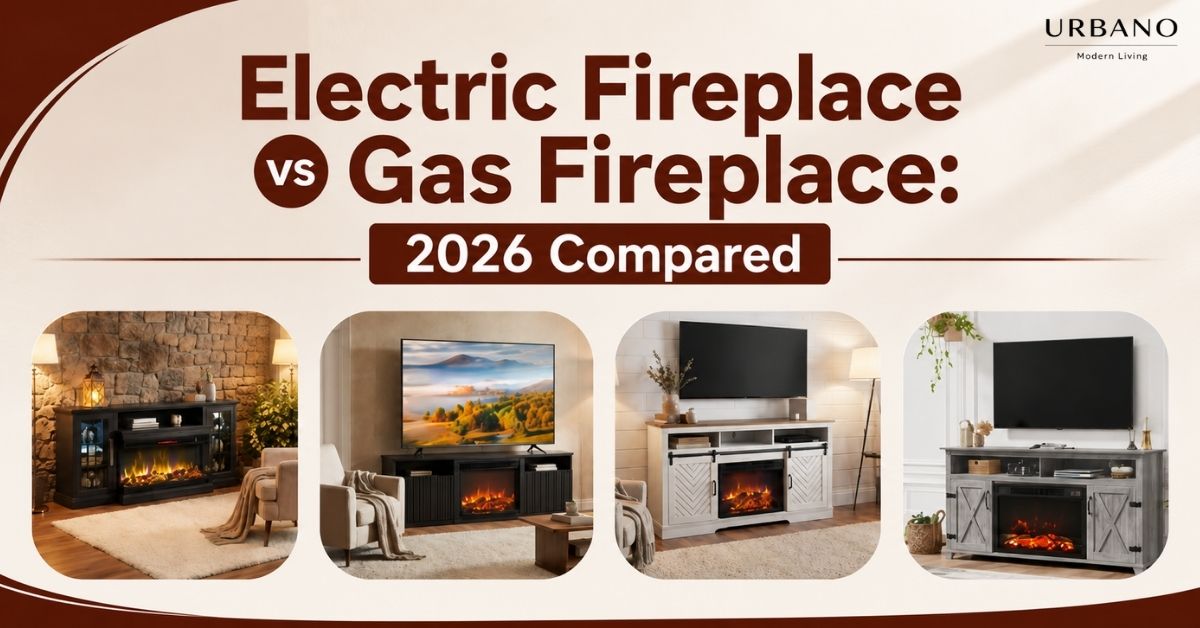
Two fireplaces, two completely different projects. One arrives in a box and plugs into a wall socket. The other needs a gas line, a vent route, a permit and a licensed installer. Every electric fireplace vs gas fireplace argument comes down to that gap. The flame effect is the least important part of it. Below is a head to head on venting, heat output, running cost, safety and what you’re allowed to install if you rent. If the answer turns out to be electric, the fireplace TV stands with LED flames are where most people land, since they solve the heat and the media wall in one piece of furniture.
Gas gives you real flame and real heat, at the price of venting, permits and a professional install. Electric gives you a plug, a heater capped at 1500 watts and zero building work. Pick gas if the fireplace has to heat a large room and you own the property. Pick electric if you want flame, mild supplemental warmth and no structural changes.
| Factor | Electric fireplace | Gas fireplace |
|---|---|---|
| Install | Plug into a standard outlet, no trade needed | Gas line, vent route, permit, licensed fitter |
| Venting | None | Direct vent, B-vent or ventless depending on model |
| Heat ceiling | 1500 watts, about 5,120 BTU | Commonly 20,000 to 40,000 BTU |
| Flame | LED, projection or water vapour | Real combustion |
| Runs on | Household electricity | Natural gas or propane |
| Yearly service | Wipe the glass, check the fan | Professional inspection |
| Moves house with you | Yes | No |
| Renter friendly | Usually | Almost never |
An electric fireplace insert is a heater with a light show. A fan blows air across a coil. Separate LEDs throw a flame image onto a screen or a bed of crystals. The flame and the heat are independent, which is why you can run the flame in July with the heat switched off.
A gas fireplace insert burns fuel. Flame and heat are the same event. You can’t have one without the other. That’s the honest difference nobody puts in the first paragraph.
An electric fireplace heater also sits in a third form that most comparisons skip. It comes built into furniture. A media console with an insert already fitted needs no wall work, no hearth and no clearance calculation. It’s the same appliance in a different wrapper.
Fireplace venting requirements are what turn a gas fireplace into a construction job. Direct vent models pull combustion air from outside and push exhaust back out through a coaxial pipe in the wall. They’re sealed from the room and they’re the common choice today. Someone has to cut that wall and route that pipe.
B-vent models exhaust upward through a chimney or a dedicated flue. That limits where the fireplace can sit, because the vertical run has to go somewhere. Ventless models burn without a flue. They’re banned or restricted in several states and in most of Canada. They release combustion moisture and byproducts into the room. Check local code before anyone quotes you for one.
Electric has none of this. A standard 120 volt outlet runs it. No flue, no clearance to combustibles above the mantel, no permit in most jurisdictions. That single fact decides the question for a large share of buyers before they read anything about flame realism.
This is where honest advice matters more than a spec sheet. An electric fireplace on a household circuit is capped at 1500 watts. Convert that and you get roughly 5,120 BTU per hour. A modest gas insert starts around 20,000 BTU. The gap is four to eight times, not a rounding difference.
| Room size | Electric at 1500 W | Gas insert to aim for |
|---|---|---|
| Up to 150 sq ft | Genuine primary heat | 10,000 to 20,000 BTU, likely oversized |
| 150 to 400 sq ft | Primary in mild climates, supplemental in cold | 20,000 to 30,000 BTU |
| 400 to 800 sq ft | Supplemental only | 30,000 to 40,000 BTU |
| Over 800 sq ft or open plan | Ambience, not heating | 40,000 BTU or a zoned system |
Insulation, ceiling height and window area move these numbers. A well sealed 300 square foot den in Georgia behaves nothing like a draughty 300 square foot room in Minnesota. Treat the table as a starting point and size up if the room loses heat fast.
Four units from the Urbano Mart range, each solving the media wall and the fireplace together.
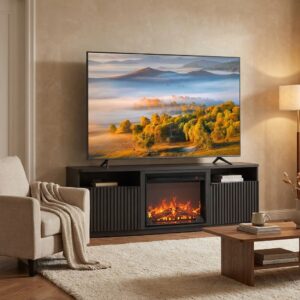
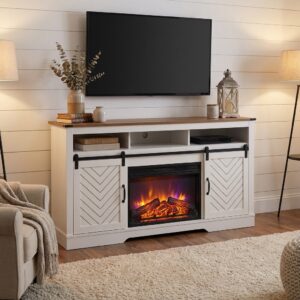
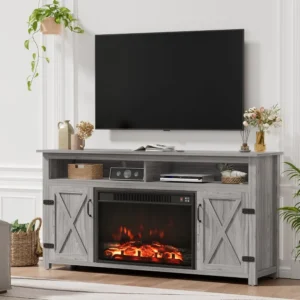
68 inches wide by 15.8 deep by 22.1 high in engineered wood, holding a TV up to 75 inches and 70 pounds. The 23 inch insert runs a thermostat from 64 to 82 Fahrenheit with overheat protection, adjustable flame brightness, crackling sound and a 1 to 8 hour timer. Two fluted cabinets with adjustable shelves swallow consoles and cables. The low 22 inch height suits a sofa, not a standing-height room.
58 by 16 by 34 inches, which is the tall option here. Three open top compartments plus barn-door shelving, multicolour flame effects and full remote control over colour, brightness and heat. At 34 inches high it lifts a 65 inch screen to standing eye level. That same height puts the screen too high for a low sofa. Measure your seated eye line first.
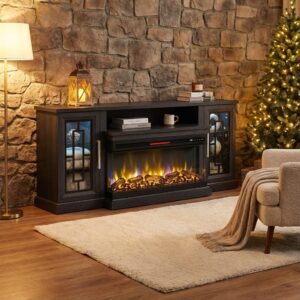
74.99 inches wide by 19.69 deep by 31.69 high, with a three sided glass fire box that reads as a real hearth from across the room. Customisable flame colours, ember effects and brightness, plus barn-door cabinets and open shelving in a woodgrain farmhouse finish. It’s the closest electric gets to the look people want gas for. It also needs the wall width. Check that 75 inch span before ordering.
A 26 inch integrated fireplace in a rustic farmhouse frame, the largest insert of these four. A wider fire box throws a larger flame picture, which matters more than heat rating for anyone buying on looks. Good fit for a room already leaning barn wood and black metal. A modern minimal room will fight it.
Here’s the failure nobody warns you about. A 1500 watt heater draws around 12.5 amps. A standard 15 amp household circuit gives you 15 amps in theory. Continuous loads are supposed to stay under 80 percent of that, which is 12 amps. So an electric fireplace on full heat is already at the ceiling of the circuit it sits on. Add a 65 inch TV, a soundbar, a console and a lamp on that same circuit and the breaker trips. People blame the fireplace. The circuit is the problem.
Two fixes. Either run the fireplace on its own outlet on a different circuit from the entertainment gear or pick a unit with a lower heat setting. The 70 Inch Modern Fireplace TV Stand with LED Electric Fireplace offers 750 and 1500 watt modes. The 750 setting halves the draw while keeping the flame. Never run either through an extension lead or a power strip.
Electric costs are simple arithmetic. Multiply the wattage by the hours you run it, divide by 1000, then multiply by your utility’s rate per kilowatt hour. A 1500 watt unit for three hours is 4.5 kilowatt hours. Your rate does the rest. Gas costs depend on your therm rate, the burner size and how much heat the vent carries outside. Sealed direct vent models keep most of it.
Older B-vent designs lose a real share up the flue. Maintenance splits cleanly. Electric asks for a glass wipe and a dust of the fan intake. Gas asks for a yearly inspection of the burner, the vent and the gas connection by someone qualified. Budget that as a fixed annual line, not an optional one.
Gas brings combustion into the house. That means carbon monoxide detectors on every floor, annual servicing and immediate action on any gas smell. Sealed direct vent units are the safest gas format because the burn chamber never opens into the room. Electric brings electrical load. The risks are circuit overload, damaged cords and blocked air intakes.
Keep the intake clear of rugs and blankets, plug straight into a wall outlet. Check the cord each season. Both get hot at the glass. Electric glass typically stays cooler than gas glass, though neither is safe for a toddler’s palm. Screens and guards apply to both.
This section decides the question for millions of people and almost no comparison covers it. Gas installation alters the building. It needs the freeholder’s consent, usually a permit, sometimes an HOA architectural review. In many leases it’s simply not permitted. Even where a gas line already exists, adding an insert is rarely something a tenant can authorise.
Electric changes nothing structural. A plug-in unit or a fireplace console is furniture. It leaves when you leave, it needs no consent and it takes no equity with it. If you expect to move within five years, that portability is worth more than any efficiency figure. Check your lease for portable heater clauses before buying. Some buildings restrict space heaters over a stated wattage, which is another argument for a unit with a 750 watt mode.
One reader wanted a fireplace in a 320 square foot living room in a rented apartment. Gas was never available to them. A console with a 23 inch insert gave flame year round, took the edge off spring evenings. Moved with them the following year.
Another owned a 900 square foot open plan ground floor and wanted the fireplace to carry the heating load. At that size an electric unit is decoration. A direct vent gas insert sized around 40,000 BTU was the only option that met the brief. The vent route through an exterior wall made it practical.
The Urbano Mart Team covers furniture, fireplace consoles and home decor for customers across the United States, from a business formed in Michigan in 2022. The team handles electric fireplace media units daily. The comparisons here reflect the questions customers ask before they buy.
The electric fireplace vs gas fireplace decision is really a question about your building, not your taste. Gas wins on heat and real flame if you own the property and can vent it. Electric wins on cost of entry, portability and freedom from permits, with the 1500 watt ceiling as its honest limit. Once you’ve settled that, browse the electric fireplace TV stands or contact Urbano Mart at sales@urbanomartllc.com or +1 313 487 8379, Monday to Friday, 9:00 AM to 5:00 PM EST. Free shipping applies across the USA except HI, PR, AK and GU, with delivery in 5 to 8 working days.