

Furniture shops use modular and sectional as if they mean the same thing. They don’t. A sectional is one sofa cut into shipping-sized pieces that bolt into a shape the designer chose. A modular sofa is a set of independent seats that you arrange and rearrange however the room needs. So what is a modular sofa in practice? It’s furniture that survives a house move, a new baby, a rearranged living room and a worn-out cushion without becoming useless. Below are the real pros, the drawbacks nobody lists, plus the doorway maths that decides whether either type gets into your home. The modular sectional sofas and sleeper sofas further down show what the format looks like at each size.
A modular sofa is built from separate seating blocks that stand alone and connect in any order. A sectional is a fixed L or U shape delivered in pieces. Modular wins on flexibility, moving and replacing one worn section. Sectional wins on a cleaner unbroken silhouette and usually a lower price for the same seat count.
| Factor | Modular sofa | Sectional sofa |
|---|---|---|
| Shape | You choose. Change it later | Fixed L or U, chosen at purchase |
| Pieces | Independent seats that stand alone | Parts that only work joined |
| Moving house | Each piece travels alone | Often needs two people and planning |
| Doorways | Piece by piece, usually simple | The largest piece sets the limit |
| Replacing a worn part | Swap one module | Usually replace the whole sofa |
| Look | Visible joins between blocks | Continuous line, fewer seams |
| Best for | Renters, changing rooms, awkward layouts | Settled rooms with a known layout |
Three Things That Make a Modular Sofa
Three things. A sofa needs all three to earn the label. Each piece works alone. Pull one block out of the group and it’s still a usable seat, not a bare frame missing an arm. That’s the test most so-called modular sofas fail.
The pieces connect without tools. Clips, brackets or interlocking bases hold the blocks together and release without hardware. If assembly needs a hex key each time you move it, you own a sectional.
The order can change. Left arm and right arm pieces aren’t fixed roles. A chaise can move from one end to the other. A corner can become a middle seat.
A modular couch built this way behaves like building blocks. A sectional behaves like a jigsaw with one correct answer.
The l shaped sectional is the format most people picture. One long run, one short run, a corner joining them. It looks settled because it is settled. Once the corner is in place the room has been decided. A chaise sectional sofa adds a lounger at one end. On a traditional sectional that chaise is either left facing or right facing. You choose at checkout. Get it wrong against your room and the return is a freight collection, not a parcel.
A reconfigurable sectional, which is what modular really means, moves that decision to any Saturday afternoon. The same blocks make an L this year and two facing sofas next year. For anyone who isn’t certain where the television is going to live, that’s worth more than the seam-free look. One honest point in the other direction. A sectional’s unbroken run of upholstery does look calmer than a line of joined cubes. If your room is formal and settled, that matters.
Four modules gives you more layouts than most people try.
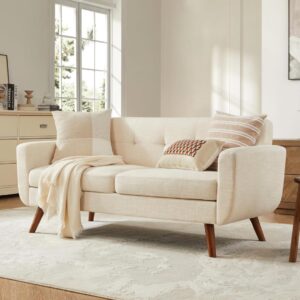
Four pieces from the Urbano Mart range across the size spread.
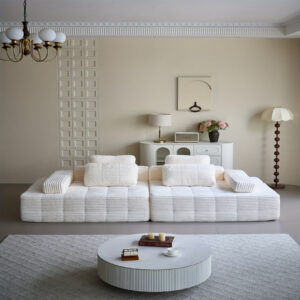
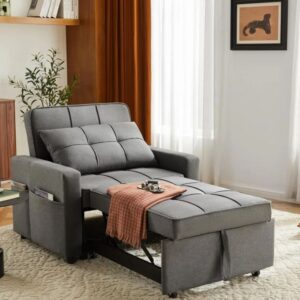
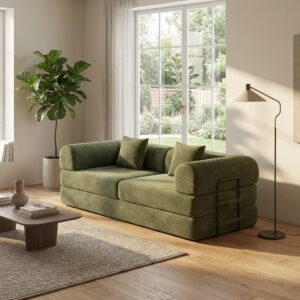
110.38 inches long by 45.27 deep by 25.59 high, seating four across two independent modules that each stand alone. Striped corduroy over memory foam, light enough for one person to move. Pet friendly against light scratches. The low 25.59 inch back suits an open plan room where you see over the sofa. Anyone wanting a high supportive back for long evenings should look elsewhere.
79 wide by 35.5 deep by 26.7 high with removable armrests, backrest and base, which is what lets it work as a sofa, a sleeper, a lounge bed or a sectional-style pair. Reinforced steel frame, high density foam, non-slip cushions, 80 pounds total. It’s the piece for a studio or a guest room. The 15.7 inch seat height is low, which some people find hard to rise from.
A 65.2 inch loveseat seating two to three, in tufted linen on an FSC certified wood frame, rated to 660 pounds. Not modular. That’s the point of including it. In a small room a single well-made loveseat beats four modules crammed against three walls. Skip it if you need a piece that can grow later.
A single-seat unit that folds from armchair to recliner to bed across five backrest positions, on a steel frame in cotton-linen upholstery, rated to 350 pounds. Buy two and you have a genuinely modular pair that separates for guests. As one piece it seats exactly one person. It’s a companion to a sofa rather than a replacement.
This is where sofa purchases actually fail. Almost no comparison puts numbers on it. A standard US interior door is 30 to 32 inches wide. An exterior door is usually 36. A one-piece sofa gets through if either its height or its depth is smaller than the door width, because you can turn it on its side. Depth is the number that matters most, since a 45 inch deep sectional turned upright is 45 inches of stubborn frame at a hallway corner.
Now do the same maths on modules. Split a 110 inch four-seater into two independent blocks and each one is around 55 inches long by 45 deep. Turned on end, it walks through a 32 inch doorway without drama. One person can carry it.
Do this before ordering. A freight return on a sofa costs more than most people expect.
Renters, first. Modular follows you between apartments with wildly different room shapes and it never needs to fit one specific corner. People with awkward rooms, second. Bay windows, radiators under the long wall, doors in inconvenient places. Modules work around all three because they don’t demand a fixed footprint.
Households that change, third. Growing families, roommates coming and going, a room that has to be a home office by day. If none of those apply and you know exactly where the sofa is going for the next decade, a fixed sectional gives you a cleaner line for less money. That’s a real answer, not a hedge.
One reader had a 12 by 14 foot living room with a bay window and a door in the corner. Every L shaped sectional they measured blocked either the window or the doorway. Four modules in a straight run along the long wall, with one pulled out as a chaise, solved a room that no fixed shape fitted.
Another lived in a settled house with a wide open living room and no plans to move. They bought a fixed sectional, paid less per seat. Got the unbroken silhouette they wanted. Modular would have been the wrong recommendation for them.
The Urbano Mart Team covers sofas, sleepers and living room furniture for customers across the United States, from a business formed in Michigan in 2022. Sizing and doorway questions come up on almost every sofa order. The specifications quoted here come from the products the team ships.
What is a modular sofa? Independent seats that stand alone, connect without tools and change order whenever the room does. Buy modular if your space or your life is still moving. Buy a fixed sectional if both are settled and you want the cleaner line. Either way, measure your doorways before you order anything. Browse the living room sofas or contact Urbano Mart at sales@urbanomartllc.com or +1 313 487 8379, Monday to Friday, 9:00 AM to 5:00 PM EST. Free shipping applies across the USA except HI, PR, AK and GU, with delivery in 5 to 8 working days.