
A 65 inch TV is not 65 inches wide. It’s about 56.7 inches wide. That single fact is why people order a console, wait a week for delivery, then find the television overhanging both ends. Learning how to measure a tv takes two minutes with a tape measure. Knowing what to do with that number is the part that saves the return shipping. Below you’ll find the diagonal rule, a computed size chart, the foot-spacing check almost nobody does, plus how wide a stand actually needs to be. If you’re already at the furniture stage, the barn door and rustic wood TV stands list their widths so you can match them to the numbers here.
TV sizes are quoted as the diagonal of the visible screen, corner to corner, excluding the bezel and the stand. For any 16:9 television, screen width is roughly the diagonal times 0.87 and screen height is the diagonal times 0.49. Measure your own set corner to corner across the glass. Then measure the total width including the frame, then the distance between the outer edges of the feet. Those three numbers are what the furniture has to fit.
| Measurement | How to take it | What it’s for |
|---|---|---|
| Screen diagonal | Bottom left corner of the glass to top right corner of the glass | Confirming the size class |
| Total width | Outer edge to outer edge including the frame | Minimum stand width |
| Foot span | Outer edge of one foot to outer edge of the other | Whether the TV can stand on the top at all |
| Total height on feet | Floor of the stand to the top of the frame | Eye line and shelf clearance |
| Depth on feet | Front of the frame to the back of the feet | Stand depth needed |
Manufacturers quote the diagonal of the active screen area. Corner to corner across the picture, not across the plastic frame around it. That’s the whole convention. Two things follow from it. A 55 inch and a 65 inch set are 10 inches apart on the diagonal, which works out to roughly 8.8 inches of extra width and 4.9 inches of extra height. The jump feels much bigger in a room than the number suggests.
The second thing matters more. Because the quoted number ignores the bezel, two 65 inch televisions from different brands can have different total widths. Modern sets have slim frames. The gap is usually under an inch and a half in total. On older sets it can be three inches. Always measure your own.
Four numbers, one piece of paper. Take the paper shopping.
Every modern television uses a 16:9 aspect ratio, which means the whole size chart is arithmetic rather than guesswork. The figures below are the screen area only. Add up to an inch and a half for the bezel on a current model.
| Size class | Screen width | Screen height | Comfortable stand width |
|---|---|---|---|
| 43 inch | 37.5 in | 21.1 in | 42 in or wider |
| 50 inch | 43.6 in | 24.5 in | 48 in or wider |
| 55 inch | 47.9 in | 27.0 in | 52 in or wider |
| 60 inch | 52.3 in | 29.4 in | 56 in or wider |
| 65 inch | 56.7 in | 31.9 in | 61 in or wider |
| 70 inch | 61.0 in | 34.3 in | 65 in or wider |
| 75 inch | 65.4 in | 36.8 in | 70 in or wider |
| 85 inch | 74.1 in | 41.7 in | 78 in or wider |
The stand column adds roughly two inches of visible ledge on each side. That margin isn’t decoration. It’s what stops a nudge from putting a foot over the edge.
Here’s the check that catches people out. Television feet come in two families and they behave completely differently. A centre pedestal sits under the middle of the panel. It needs a small footprint and it will happily sit on a console much narrower than the TV, though the overhang still looks wrong and still risks a knock.
Wide-set feet sit near the outer corners. On a 65-inch set, they can be 45 to 50 inches apart. If your console top is 58 inches wide with a raised lip or a recessed edge, the usable flat area might be 54 inches. Suddenly the margin is gone. So measure the foot span, then measure the flat usable top of the stand rather than its advertised width. Those two numbers decide whether the television stands up or goes on the wall.
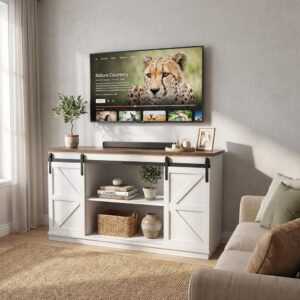
Four consoles from the Urbano Mart range with their real widths listed. You can hold them against the chart above.
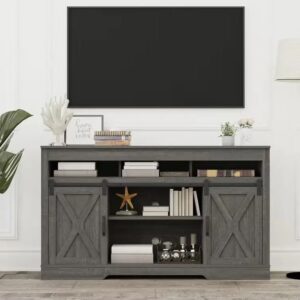
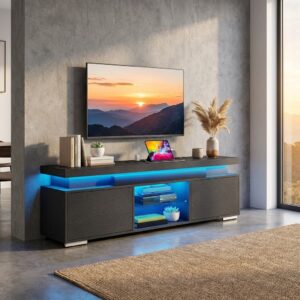
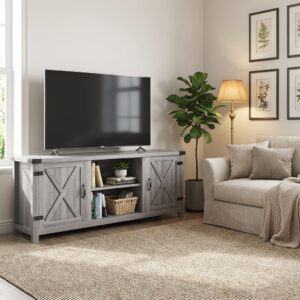
58 inches wide, 16 deep, 34 high, rated to 300 pounds and built from CARB P2 engineered wood. It’s sized for 55 to 65 inch sets. That 34 inch height is the tall option, which suits a standing-height room or a bed-facing setup. For a low sofa it lifts the screen above a comfortable eye line.
58 by 15.5 by 23.8 inches with six drawers, an adjustable shelf, two sliding barn doors and a round cable pass-through at the back. The 23.8 inch height is the sofa-friendly one. Against a 65 inch TV at 56.7 inches of screen, the margin is tight but workable if the feet are a centre pedestal.
The widest of the four at 59.1 inches, 14 deep and 19.28 high, with four AC outlets and two USB ports built in, four open shelves and two push-to-open compartments. Rated for 45 to 65 inch sets. Two people assemble it in 40 to 50 minutes. At 14 inches deep it’s the shallowest here. Check your foot depth carefully.
58 by 15.5 by 27.6 inches in white or espresso, with two barn doors on metal rails and circular cable cutouts in the back panel. The 27.6 inch height sits between the low and tall options. It’s the deep-storage choice of the group. Anyone with a 75 inch set needs to look elsewhere entirely.
Work from screen width, not size class. A tv stand for 55 inch tv needs at least 48 inches of usable top and 52 is comfortable. A 65 inch set wants 61 inches or more.
A tv stand for 75 inch tv is where most furniture ranges stop. A 75 inch screen is 65.4 inches wide. The console needs about 70 inches of flat top. The farmhouse range here tops out at 65 inch sets. For a 75 inch screen the 75 Inch Electric Fireplace TV Stand with Panoramic 3-Side Glass TV Console runs 74.99 inches wide, which clears it properly.
If the console is narrower than the screen, wall mounting is the honest answer. A screen that overhangs its furniture always looks like a mistake, whatever the spec sheet allows.
Read those labels carefully. A stand rated for 65 inch televisions is telling you the size class it was designed around, not that a 65 inch set will look right on it. Run the numbers. Three of the consoles above are 58 or 59.1 inches wide. A 65 inch screen is 56.7 inches wide before the bezel. Add a slim frame and you’re at roughly 58 inches of television on a 58 inch top. Technically it fits. Visually there’s no ledge at all.
Drop one size class and the same console looks intentional. A 60 inch set is 52.3 inches wide, which leaves nearly three inches of shoulder on each side. That’s the difference between furniture that looks chosen and furniture that looks borrowed. The rule to carry away: buy the stand for the television you own, then check that the stand is at least four inches wider than the total width you measured.
Screen centre should sit at or slightly below your seated eye level. For most sofas that puts the centre around 40 to 44 inches off the floor. Take a 65 inch screen at 31.9 inches tall, half of it is 16 inches. A console around 24 inches high lands the centre near 40 inches. That’s why the low consoles exist.
A 34 inch console with the same television puts the centre near 50 inches, which is a neck-up angle from a sofa. It works for a kitchen, a bedroom or a standing room. Match the height to where people sit, not to the look of the piece. For distance, a rough rule for a 4K set is between one and one and a half times the screen width. A 65 inch screen at 56.7 inches wide is comfortable from about five to seven feet.
One reader measured 65 inches across the frame of their television rather than the glass and shopped for a 70 inch console. The set was a 60 inch model. They ended up with nine inches of empty ledge and a room that looked unbalanced.
Another had a 65 inch set with wide-set feet spanning 48 inches, buying a 58 inch console with recessed edging. The usable flat top measured 54 inches. It fitted, with two inches to spare in total. One knock from the vacuum cleaner was all it took to teach them about wall mounts.
The Urbano Mart Team covers TV consoles, living room furniture and home decor for customers across the United States, from a business formed in Michigan in 2022. Sizing questions are the most common thing customers ask before ordering a stand. The numbers here come from the specifications on the products the team ships.
Knowing how to measure a tv comes down to four numbers: the screen diagonal, the total width, the foot span and the height on feet. Take those numbers to the furniture, not the size class printed on the box. Add four inches of stand width for a ledge that looks deliberate. When you’re ready, browse the farmhouse TV stands with their widths listed. Contact Urbano Mart at sales@urbanomartllc.com or +1 313 487 8379, Monday to Friday, 9:00 AM to 5:00 PM EST. Free shipping applies across the USA except HI, PR, AK and GU, with delivery in 5 to 8 working days.